top of page


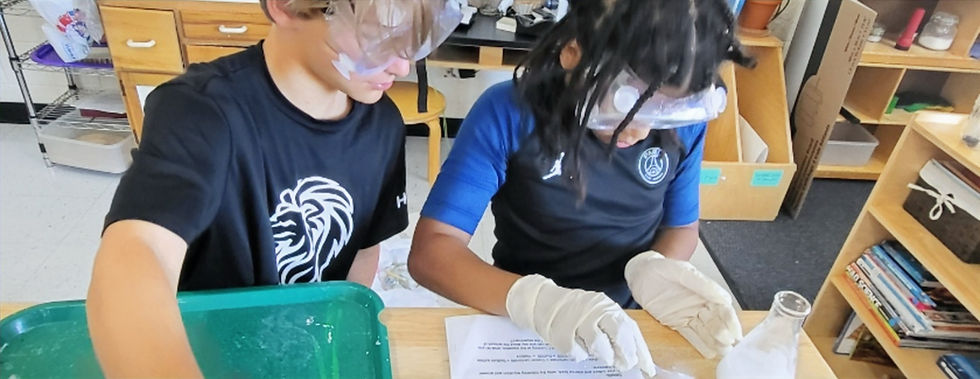
Upper Elementary Classroom
Ages 9 to 12 Years Old
At the conclusion of the Lower Elementary program, children transition to the Upper Elementary program, designed for children ages 9–12 years (4th–6th grade). While still in the same stage of development, the rising Upper Elementary learner is ready for new and different challenges—socially, physically, and cognitively. In Upper Elementary, children transition from concrete to abstract thinking. They are able to bring order to various disconnected concepts and move beyond the binary of “good or bad” as they seek to understand the motivation behind behavior. When confronted with moral issues, the Upper Elementary learner uses the power of imagination to develop new solutions.
The four walls of the classroom expand as students’ interests compel them to go into the wider community to find answers to their questions. Through this exploration, called Going Out, children experience the interconnectedness of their world and their role in—and responsibility to—the larger community.
Academics in Upper Elementary build on and expand upon those introduced in the Lower Elementary classroom. While the subjects remain the same, students deepen and broaden their knowledge while refining their skills and precision.
Areas of study in the Upper Elementary program include:
-
Language – reading applications, oral interpretation, grammar, spelling, editing, literature, the writing process
-
Mathematics and Geometry – multiples, problem-solving skills, fractions & decimals, ratios & percentages, statistics & probability, graphs, algebra readiness, points, lines & angles, measurement
-
Biology – life sciences, zoology, human anatomy, botany, scientific research
-
Geography – political geography, earth science, physics, chemistry, geology, human geography
-
History – ancient cultures & civilizations, American history, Georgia state history, civics & government
-
Spanish – vocabulary, grammar, conversational skills, reading, writing
-
Creative and Performing Arts – art, music, drama
-
Physical Education and Health – cooperative games, sports, puberty education, social-emotional learning


bottom of page